Good morning ☀️, leader of the next generation.
Technology is reshaping how the world works.
The real question is not what it can do — but how we choose to use it.
We focus on using technology to support human evolution.
Progress works when responsibility stays human.
⚡ WHAT'S AT STAKE TODAY ⚡
- 🎵📱 OpenAI bets big on audio as Silicon Valley declares war on screens
- 🏦🤖 European banks plan to cut 200,000 jobs as AI takes hold
- 🎓💼 'College dropout' has become the most coveted startup founder credential
- ⚖️🏛️ What California's new laws will mean for San Diegans starting today
- 🏭🤖 Overcoming AI Adoption Challenges in Manufacturing and Supply Chain
- 📈💰 5 Top Artificial Intelligence Stocks to Buy in 2026
- 🇮🇳💡 India's AI-ready workforce drives growth as CEOs prioritise upskilling for future success
- 📸🤖 Instagram Chief Outlines the Challenges of AI Content
- 🚀📊 DeepSeek kicks off 2026 with paper signalling push to train bigger models for less
OpenAI reorganizes teams to develop audio-first personal device within year
OpenAI bets big on audio as Silicon Valley declares war on screens

OpenAI is making a massive strategic shift toward audio-based artificial intelligence, consolidating multiple engineering, product, and research teams to completely redesign its audio capabilities. This restructuring, which occurred over recent months, aims to prepare for launching an audio-first personal device within the next year.
This pivot reflects a broader industry transformation where traditional screens are losing their dominance to voice-controlled interfaces. The technology sector is rapidly embracing audio as the primary interaction method for future devices and services.
The audio revolution is already underway across major platforms. Smart speakers have penetrated over one-third of American households, establishing voice assistants as everyday fixtures. Meta recently introduced innovative functionality for its Ray-Ban smart glasses, incorporating a sophisticated five-microphone system that enhances conversation clarity in noisy environments, essentially transforming eyewear into precision listening devices.
Google has been experimenting with "Audio Overviews" since June, converting traditional search results into engaging conversational summaries. Meanwhile, Tesla is integrating xAI's Grok chatbot into its vehicle systems, creating an advanced voice assistant capable of managing navigation, climate controls, and other functions through natural conversation.
Beyond established tech giants, numerous startups are pursuing similar audio-centric visions with mixed results. The Humane AI Pin serves as a cautionary example – its creators invested hundreds of millions into a screenless wearable that ultimately failed to gain market traction. The Friend AI pendant, marketed as a life-recording companion necklace, has generated significant privacy concerns and public skepticism.
However, innovation continues with at least two companies, including Sandbar and a venture led by Pebble founder Eric Migicovsky, developing AI-powered rings scheduled for 2026 release. These devices will enable users to interact with artificial intelligence through simple hand gestures and voice commands.
Despite varying form factors, the underlying premise remains consistent: audio represents the interface of tomorrow. Every environment – homes, vehicles, and even personal accessories – is evolving into interactive control surfaces.
OpenAI's upcoming audio model, expected in early 2026, promises significant improvements over current capabilities. The enhanced system will deliver more natural-sounding speech, manage conversational interruptions seamlessly, and enable simultaneous speaking – features that existing models cannot accomplish. The company envisions developing a complete ecosystem of devices, potentially including smart glasses or screenless speakers that function more as digital companions than traditional tools.
This strategic direction aligns with insights from former Apple design chief Jony Ive, who joined OpenAI's hardware initiatives following his company io's $6.5 billion acquisition in May. Ive has prioritized addressing device addiction issues, viewing audio-first design as an opportunity to correct the negative impacts of previous consumer technology generations.
The industry-wide movement toward audio interfaces represents more than technological advancement – it signals a fundamental reimagining of human-computer interaction, potentially reducing screen dependency while creating more natural, conversational relationships with digital systems.
European banks to eliminate 200,000 jobs through AI automation
European banks plan to cut 200,000 jobs as AI takes hold

A Morgan Stanley analysis reveals that European banks may eliminate over 200,000 jobs by 2030 as AI technology transforms the industry. This represents approximately 10% of the workforce at 35 major banks.
Back-office operations, risk management, and compliance roles face the biggest cuts, with lenders expecting 30% efficiency gains. ABN Amro plans to reduce staff by 20% by 2028, while Goldman Sachs has implemented hiring freezes through 2025. However, some industry leaders warn against eliminating junior positions too quickly, fearing long-term consequences for institutional knowledge.
🎙️ The Supercharged Podcast Is Growing
Conversations with the People Building the AI Future
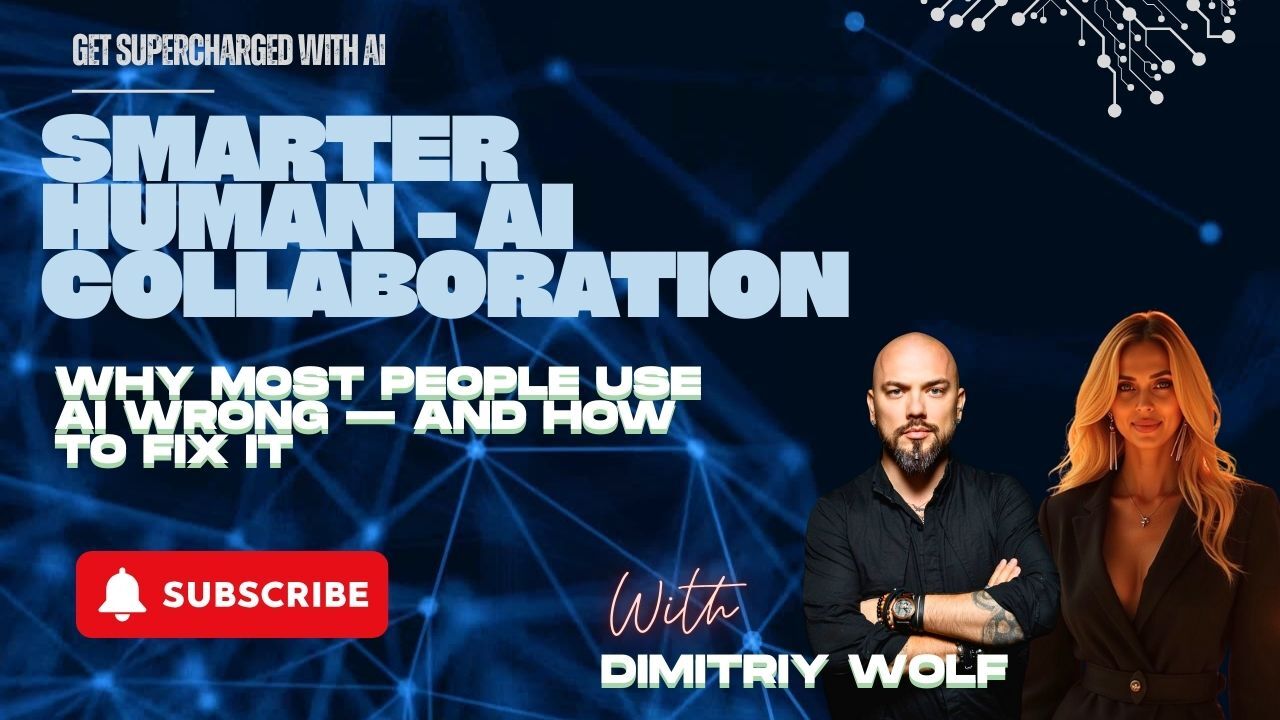
The Supercharged Podcast is becoming a place where real conversations about AI happen — beyond hype, tools, or surface-level takes.
We sit down with industry leaders, founders, builders, and operators who are actively using AI — or building AI-first businesses — to understand how it’s actually changing the way work gets done.
From strategy and systems to experimentation and execution, these are practical, honest conversations with people shaping what comes next.
⚡ Trends for the Future
DeepSeek kicks off 2026 with paper signalling push to train bigger models for less

DeepSeek proposes new architecture to train AI models more cost-effectively.
Chinese AI startup DeepSeek has started 2026 with a technical breakthrough that could reshape how foundational AI models are trained. In a new paper co-authored by founder Liang Wenfeng, the company introduces Manifold-Constrained Hyper-Connections (mHC), an innovative method designed to make AI training more cost-effective while competing with better-funded US rivals.
The research, led by 19 DeepSeek scientists including Zhenda Xie, Yixuan Wei, and Huanqi Cao, demonstrates that mHC can scale across models with 3 billion, 9 billion, and 27 billion parameters without adding significant computational burden. The team confirmed that their approach enables "stable large-scale training with superior scalability" while delivering gains with "negligible computational overhead."
This advancement builds upon hyper-connections technology first proposed by ByteDance researchers in September 2024, which improved upon ResNet architecture. ResNet, introduced by Microsoft Research Asia in 2015, has become integral to major language models like OpenAI's GPT and Google DeepMind's Nobel-winning AlphaFold system. However, it faces limitations including difficulty maintaining strong learning signals without collapsing into uniform states.
DeepSeek's innovation addresses memory cost issues that constrained previous approaches' practical scalability for large-model training. By constraining the network with a specific manifold, mHC ensures both computational and cost efficiency. The researchers believe their method "will help address current limitations and potentially illuminate new pathways for next-generation foundational architectures."
The paper's publication reflects the increasingly collaborative culture among Chinese AI companies sharing research publicly. Industry experts note that DeepSeek's papers often signal the technical direction of upcoming model releases, with speculation mounting about a potential new major model launch before February's Spring Festival, following the pattern of last year's groundbreaking R1 model release.

⚡ Let’s Make AI Actually Useful:
What Would Move the Needle in *Your* Industry?
AI has potential — but generic advice rarely helps.
What would be genuinely valuable for AI to do in your industry right now?
• Automate a painful workflow?
• Improve decision-making?
• Replace a manual process that wastes time?
• Help your team upskill faster?
Tell us what you’d want AI to handle — or where you feel stuck.
We’re using these insights to curate **industry-specific trainings, live webinars, and practical guidance** you can actually apply.
AI will be humanity's most powerful instrument for positive change, helping us achieve breakthroughs that seemed impossible and create a future where innovation lifts everyone.
Cameron Adams is the co-founder and Chief Product Officer of Canva, where he has led the design and user experience that makes professional graphic design accessible to millions of people without formal design training. His expertise in creating intuitive, delightful interfaces has been fundamental to Canva's success in democratizing design, and he continues to advocate for using AI and technology to empower creativity and enable people to communicate visually regardless of their skill level.
🌡️ Use the Satisfaction Thermometer to show us how much you enjoyed The Supercharged today ;)

The Supercharged is aiming to be the world's #1 AI business magazine and is on a mission to empower 1,000,000 entrepreneurs worldwide by 2025, guiding them through the transition into the AI-driven creative age. We're dedicated to breaking down complex technologies, sharing actionable insights, and fostering a community that thrives on innovation, to become the ultimate resource for businesses navigating the AI revolution.
The Supercharged is the #1 AI Newsletter for Entrepreneurs, with 25,000 + readers working at the world’s leading startups and enterprises. The Supercharged is free for the readers. Main ads are typically sold out 2 weeks in advance. You can book future ad spots here.
I'm sending this email because you registered for one of our workshops or our affiliates brought you. You can unsubscribe at the bottom of each email at any time.
