In partnership with

Good morning ☀️, leader of the next generation.
Technology is reshaping how the world works.
The real question is not what it can do — but how we choose to use it.
We focus on using technology to support human evolution.
Progress works when responsibility stays human.
⚡ WHAT'S AT STAKE TODAY ⚡
- 🚗🤖 Motional puts AI at center of robotaxi reboot as it targets 2026 for driverless service
- 🔍⚕️ Google removes AI Overviews for certain medical queries
- 🔧📄 OpenAI is reportedly asking contractors to upload real work from past jobs
- 🚫🌏 Indonesia and Malaysia block Grok over non-consensual, sexualized deepfakes
- 💰⚠️ Grok AI is monetising abuse and government must act, Refuge warns
- 🏛️📊 Yates Legislature to consider AI policy, labor agreement, and public hearing today
- 💼📈 Infosys explains the gap between AI adoption and AI-first work in today's workplaces
- 👥⚡ Human & AI Workforce Management: The New Staffing Crisis Nobody Knows They're In
- 🛒🤖 Google announces a new protocol to facilitate commerce using AI agents
Motional pivots to AI-first approach for 2026 Las Vegas robotaxi launch
Motional puts AI at center of robotaxi reboot as it targets 2026 for driverless service

After facing significant challenges including missed deadlines, massive layoffs, and the loss of a key financial backer, autonomous vehicle company Motional has undergone a complete transformation. The joint venture between Hyundai Motor Group and Aptiv is now betting its future on an AI-first approach to self-driving technology.
Two years ago, Motional stood at a critical crossroads. The company had failed to meet its promised deadline for launching a driverless robotaxi service with partner Lyft. When Aptiv withdrew its financial support, Hyundai stepped in with an additional $1 billion investment to keep the company afloat. Multiple rounds of layoffs, including a devastating 40% workforce reduction in May 2024, shrunk the team from 1,400 employees to fewer than 600.
Rather than continuing on a failing path, Motional made the bold decision to pause operations and completely reimagine its approach. The company has now emerged with a revamped strategy centered on artificial intelligence and a concrete timeline for commercial deployment.
"We saw that there was tremendous potential with all the advancements that were happening within AI," explained Motional CEO Laura Major. "While we had a safe, driverless system, there was a gap to getting to an affordable solution that could generalize and scale globally."
The transformation involved shifting from a traditional robotics approach to one built on AI foundation models. Previously, Motional's system relied on multiple individual machine learning models handling different functions like perception and tracking, combined with rules-based programming. This created a complex web of software that was difficult to scale and adapt to new environments.
The new architecture consolidates these smaller models into a single backbone system, similar to the transformer technology that powers ChatGPT. This end-to-end approach promises significant advantages for expansion and cost optimization.
"This is really critical for generalizing more easily to new cities, new environments, new scenarios," Major noted. "For example, the traffic lights might be different in the next city you go to, but you don't have to redevelop or re-analyze those. You just collect some data, train the model, and it's capable of operating safely in that new city."
Motional's roadmap for commercial deployment is aggressive but methodical. The company has already begun testing with employees using robotaxis equipped with human safety operators. Later this year, this service will expand to the public through a partnership with an unnamed ride-hailing company. By the end of 2026, the safety operators will be removed entirely, launching a fully autonomous commercial service in Las Vegas.
A test ride in Las Vegas demonstrated the system's improved capabilities. The Hyundai Ioniq 5 successfully navigated challenging scenarios that previously required human intervention, including the notoriously difficult pickup and drop-off areas at hotels like the Aria. The vehicle autonomously maneuvered around stopped taxis, unloading passengers, and various obstacles while changing lanes as needed.
While the system showed impressive progress, challenges remain. The vehicle took considerable time to navigate around a double-parked delivery van, and the passenger interface graphics are still under development. However, no safety operator interventions were required during the demonstration.
Major emphasized that Hyundai's long-term commitment provides stability for the ambitious timeline. The ultimate vision extends beyond robotaxis to integrating Level 4 autonomous driving capabilities into personal vehicles.
"Robotaxis, that's stop number one, and huge impact," Major said. "But ultimately, I think any OEM would love to also integrate that into their cars."
Motional's transformation represents a broader trend in the autonomous vehicle industry, where companies are increasingly leveraging advances in AI to overcome technical and economic barriers that have hindered widespread deployment of self-driving technology.
Get the 90-day roadmap to a $10k/month newsletter

Creators and founders like you are being told to “build a personal brand” to generate revenue but…
1/ You can be shadowbanned overnight
2/ Only 10% of your followers see your posts
Meanwhile, you can write 1 email that books dozens of sales calls and sells high-ticket ($1,000+ digital products).
After working with 50+ entrepreneurs doing $1M/yr+ with newsletters, we made a 5-day email course on building a profitable newsletter that sells ads, products, and services.
Normally $97, it’s 100% free for 24H.
Google pulls AI summaries after health misinformation concerns raised
Google removes AI Overviews for certain medical queries

Google has removed AI Overviews from certain medical queries after investigation revealed misleading health information. The Guardian found AI summaries provided liver test ranges without considering factors like age, sex, or ethnicity, potentially causing misinterpretation of results.
While Google removed overviews for specific liver-related queries, variations still triggered AI-generated responses. A Google spokesperson stated their clinical team found much information was accurate and sourced from quality websites, but wouldn't comment on individual removals.
🎙️ The Supercharged Podcast Is Growing
Conversations with the People Building the AI Future
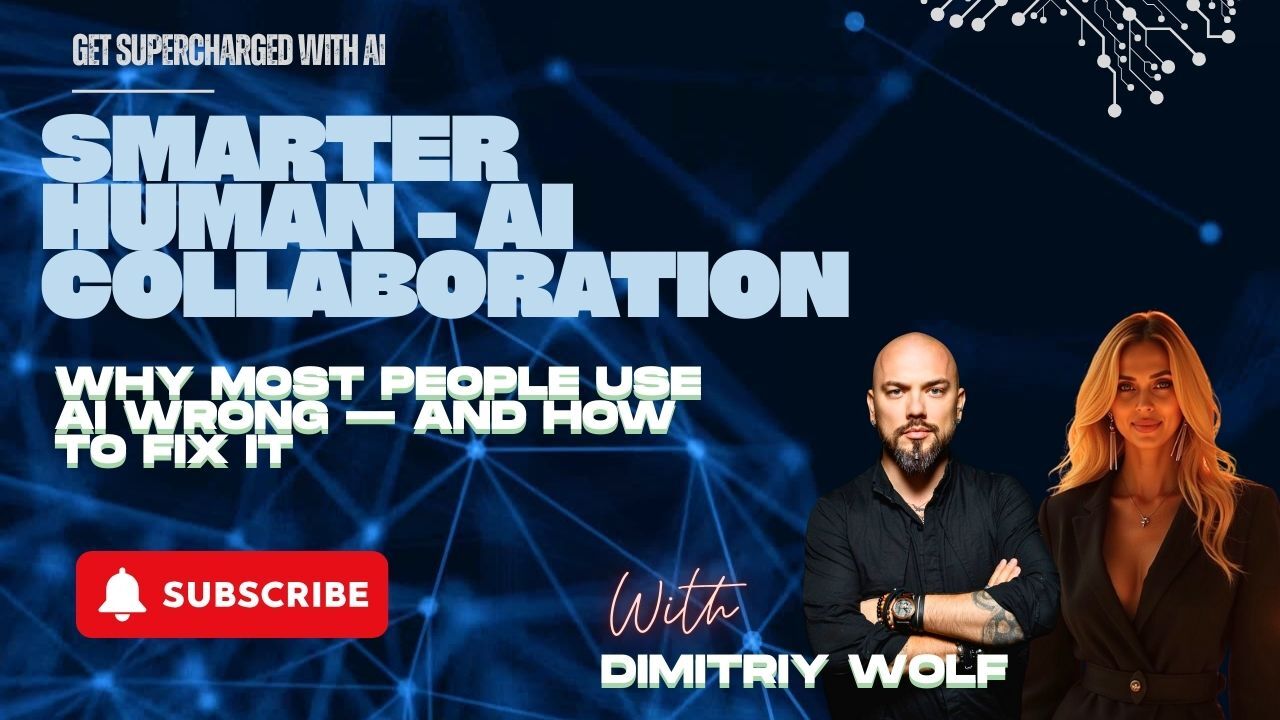
The Supercharged Podcast is becoming a place where real conversations about AI happen — beyond hype, tools, or surface-level takes.
We sit down with industry leaders, founders, builders, and operators who are actively using AI — or building AI-first businesses — to understand how it’s actually changing the way work gets done.
From strategy and systems to experimentation and execution, these are practical, honest conversations with people shaping what comes next.
⚡ Trends for the Future
Google announces a new protocol to facilitate commerce using AI agents

Google launches Universal Commerce Protocol for AI-powered shopping experiences.
Google unveiled the Universal Commerce Protocol (UCP) at the National Retail Federation conference, introducing a new open standard designed to revolutionize AI agent-based shopping. The protocol was developed in collaboration with major retailers including Shopify, Etsy, Wayfair, Target, and Walmart.
The UCP enables AI agents to work seamlessly across different stages of the customer journey, from product discovery to post-purchase support. Rather than requiring separate connections with various agents, this unified standard streamlines the entire shopping process. The protocol integrates with existing systems like Agent Payments Protocol, Agent2Agent, and Model Context Protocol, allowing businesses to select specific extensions that meet their needs.
Google plans to implement UCP for eligible product listings in AI mode within search results and Gemini apps, enabling direct checkout from U.S.-based retailers. Customers will be able to complete purchases using Google Pay with saved shipping information from Google Wallet, with PayPal support coming soon.
Shopify CEO Tobi Lutke highlighted the potential for AI agents to create serendipitous shopping experiences, connecting consumers with products they might never have discovered through traditional search methods. Shopify also announced a similar integration with Microsoft Copilot for streamlined checkout experiences.
Additional features include the ability for brands to offer real-time discounts during product searches and new data attributes in Google's Merchant Center for better product visibility in AI search results. Google is also launching branded AI-powered Business Agents for merchants, with companies like Lowe's, Michael's, Poshmark, and Reebok already participating.
The search giant introduced Gemini Enterprise for Customer Experience, a comprehensive suite for retailers and restaurants to handle shopping and customer service operations. This initiative reflects the broader industry trend, with companies like Amazon, Walmart, and OpenAI all developing AI-powered commerce solutions. Adobe recently reported that generative AI-driven traffic to seller sites increased by 693.4% during the holiday season, demonstrating the growing impact of AI on e-commerce.

⚡ Let’s Make AI Actually Useful:
What Would Move the Needle in *Your* Industry?
AI has potential — but generic advice rarely helps.
What would be genuinely valuable for AI to do in your industry right now?
• Automate a painful workflow?
• Improve decision-making?
• Replace a manual process that wastes time?
• Help your team upskill faster?
Tell us what you’d want AI to handle — or where you feel stuck.
We’re using these insights to curate **industry-specific trainings, live webinars, and practical guidance** you can actually apply.
AI will be humanity's most transformative partner, amplifying our creativity and problem-solving abilities to achieve breakthroughs that seemed impossible just yesterday.
Max Levchin is the co-founder of PayPal and founder of Affirm, where he has been a pioneer in digital payments and financial technology innovation for over two decades. His work in creating secure online payment systems helped enable e-commerce to flourish globally, and he continues to advocate for using AI and machine learning to make financial services more transparent, accessible, and fair for consumers while fighting fraud and protecting user data.
🌡️ Use the Satisfaction Thermometer to show us how much you enjoyed The Supercharged today ;)

The Supercharged is aiming to be the world's #1 AI business magazine and is on a mission to empower 1,000,000 entrepreneurs worldwide by 2025, guiding them through the transition into the AI-driven creative age. We're dedicated to breaking down complex technologies, sharing actionable insights, and fostering a community that thrives on innovation, to become the ultimate resource for businesses navigating the AI revolution.
The Supercharged is the #1 AI Newsletter for Entrepreneurs, with 25,000 + readers working at the world’s leading startups and enterprises. The Supercharged is free for the readers. Main ads are typically sold out 2 weeks in advance. You can book future ad spots here.
I'm sending this email because you registered for one of our workshops or our affiliates brought you. You can unsubscribe at the bottom of each email at any time.
