Sponsored by

Find Your Best-Fit 3PL.

Skip weeks of sales demos. Tell Fulfill your products, order volume, and shipping zones, and our team screens a network of 2,800+ vetted 3PLs to hand you a ranked shortlist of your best-fit partners. You reach out to the matches you like, get pricing directly from them, and decide on your own terms, whether that means switching to a better fit or negotiating with your current 3PL. There is no fee and no pressure, and most brands get their shortlist within days. See your best-fit matches.
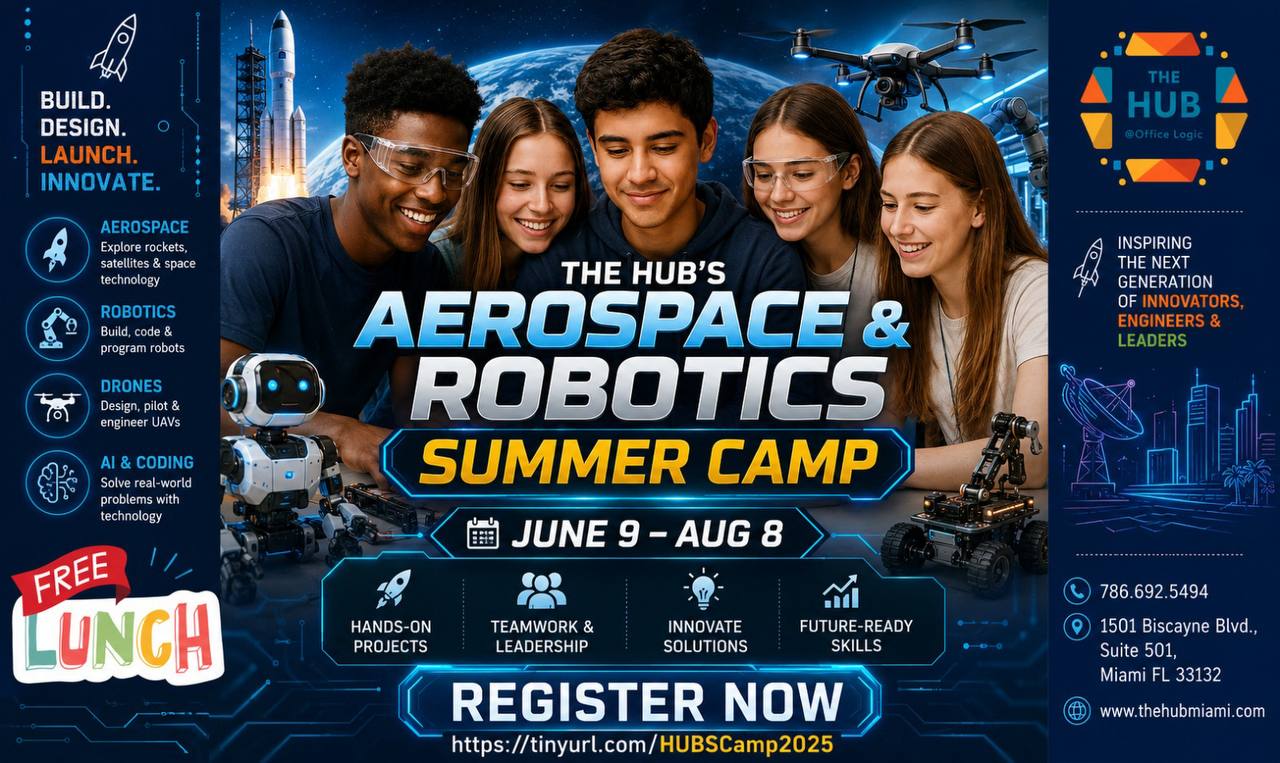
In the next 5 years, AI is expected to reshape nearly every industry on the planet. The World Economic Forum projects 92 million jobs will be displaced by 2030 — while 170 million new ones will be created. The kids who win that shift won't be the ones who avoided technology. They'll be the ones who learned to build with it.
That's why this summer matters.
The HUB's 2026 Aerospace & Robotics Summer Camp gives students ages 12–18 hands-on experience with the skills that will actually be in demand — AI, robotics, drone simulation, space technology, and entrepreneurship. Not theory. Not screens. Real projects, real teamwork, real confidence.
No fee. No problem. We will give you a call to see if you’re the right fit.
Fill out the form to reserve a spot →
When asked "How did you hear about us?" — please mention the Supercharged newsletter.
Good morning ☀️, leader of the next generation.
We will talk about agents. AI agents.
They will change the way how we do business, how we interract and even how we do our everyday lives.
Agents will build business.
Agents will organize your day.
Agents will fill up your fridge.
I will let that sit in here for a while, so we can imagine and build the future together one agent at a time...
⚡ WHAT'S AT STAKE TODAY ⚡
- 🚗🌍 Decart's new world model can simulate hours of photorealistic driving — with some caveats
- 🎵🤖 Warner Music acquires AI attribution startup Sureel AI
- 🍎💬 Hey, Siri, here's what I actually want from AI
- 💰🚀 How Justin Ernest invested nearly $500M into hot startups without a traditional VC fund
- 🔍💸 Google just fired a warning shot in the AI subscription price wars
- 🤖🏢 Jedify raises $24M to help companies arm AI agents with context on their business
- 🚀🌙 The three hard-tech moonshots fueling SpaceX's unbelievable IPO
- 💻🔓 Datadog veterans launch AI coding startup Niteshift on a bet against Big AI lock-in
- 🇮🇳🏗️ Meta signs first AI data center deal in India with Reliance
Decart launches photorealistic AI driving simulator, but long-term consistency remains a challenge.
Decart's new world model can simulate hours of photorealistic driving — with some caveats

AI startup Decart has unveiled Oasis 3, an interactive world model capable of generating photorealistic driving environments in real time. Available immediately via API, the model is initially aimed at autonomous vehicle companies that need to simulate rare or dangerous driving scenarios at scale, with plans to expand into robotics and other physical AI applications.
But Decart's broader ambition goes beyond the AV industry. The company wants to build a developer ecosystem around world models, much like OpenAI did with language models. "It's going to be the first usable world model that people can actually program on top of," said Dean Leitersdorf, co-founder and CEO. Decart already has a community of over 100,000 developers building on its real-time video model, Lucy, and Oasis 3 is designed to extend that foundation into physical AI. Access is priced at $0.02 per second, with enterprise pricing available depending on use case.
The launch comes weeks after Decart raised $300 million, pushing its valuation to nearly $4 billion. Strategic investors include Toyota, Adobe, eBay, and Nvidia — all of whom Leitersdorf views as potential customers. The funding followed strong demand for Decart's existing models in e-commerce and livestreaming.
Oasis 3 stands out for its photorealism and its ability to generate environments indefinitely — a major advantage for AV developers stress-testing edge cases. The model produces multi-camera environments, including one front-facing and two side-facing views. Much of this capability is powered by Decart's DOS (Decart Optimization Stack), proprietary software that runs models efficiently across Nvidia, Amazon, and Google hardware. Leitersdorf claims this vertical integration makes Decart's models more than ten times cheaper to run than competitors, and that the company has spent "drastically less" than $100 million in its entire lifetime.
In hands-on testing, Oasis 3 delivered the most photorealistic results of any world model tested, generating a convincing New York City street scene from a single text prompt. The ability to explore that environment for extended periods also sets it apart from rivals like Google's Genie 3 or World Labs's Marble.
However, the model has notable limitations. While initial scenes are impressive, the environment degrades quickly as you move through it. The New York street scene gradually lost its character, morphing into a generic urban landscape. Attempting to retrace a route revealed an entirely new environment had replaced the original. Controls were also unresponsive at times, making it difficult to steer the vehicle accurately — a problem shared by other world models.
A more fundamental issue is that the car can drive straight through other vehicles, exposing the model's inability to simulate physics properly. Leitersdorf acknowledges this is a "major research problem," explaining that training data is heavily skewed toward normal driving rather than collisions.
These consistency issues are partly architectural. Oasis 3 is auto-regressive, generating one frame at a time and referencing previous frames to determine what comes next. At tens of frames per second, each containing roughly 8,000 tokens, the model's context window fills up rapidly. "We're researching how to do longer context to store millions more tokens, and how to compress the memory into fewer tokens," Leitersdorf said.
A partial fix may come in the next version of the model, which will allow world generation to begin from a video of a real environment rather than just a text prompt or image. Leitersdorf believes this will improve long-term coherence, though he openly acknowledges that world models as a field are still in their early stages.
Despite the current shortcomings, Leitersdorf is optimistic about what happens when developers start experimenting. He draws a direct parallel to the early days of large language models and the unexpected applications that emerged once APIs became widely available. "When we talk again in three months, we'll be like, 'Here's 100 developers that all built 100 different applications with Oasis that surprised all of us,'" he said.
Don't be the one behind at standup

Your team is already talking about the launch you missed. TLDR is the 5-minute daily brief that keeps you ahead, curated by ex-Google and Anthropic engineers. Free, and read by 7M+ subscribers.
Warner Music buys AI startup to protect artists' intellectual property rights.
Warner Music acquires AI attribution startup Sureel AI

Warner Music Group (WMG) has acquired Sureel AI, a startup whose patented technology creates "AI DNA" for songs, tracing how AI models use musical elements. The move allows WMG to better monitor when its artists' work is used in AI-generated content or AI training.
Founded in 2022, Sureel offers IP provenance, compliance reporting, and a name, image, and likeness (NIL) attribution suite covering voice clones and AI avatars. It will continue operating as a standalone platform.
WMG, which previously sued and later licensed deals with AI music startups Suno and Udio, aims to ensure artists retain full control over their creative identities. Financial terms were not disclosed.
🎙️ The Supercharged Podcast Is Growing
Real Conversations with the People Building the AI Future

The Supercharged Podcast is quickly becoming a space for real, unfiltered conversations about AI — beyond the hype, tools, and surface-level takes.
Each episode dives deep with founders, operators, and builders who are actively working with AI — or building AI-first companies — to uncover how it’s truly changing the way work gets done.
From strategy and systems to real-world execution, these conversations are practical, honest, and focused on what actually works — not just what sounds good.
⚡ Trends for the Future
Meta signs first AI data center deal in India with Reliance

Meta partners with Reliance to build its first AI data center in India.
Meta has announced its first AI infrastructure investment in India, partnering with Reliance Industries to develop a 168-megawatt AI-enabled data center in Jamnagar, Gujarat. The facility, expected to be ready within two years, will be powered by renewable energy and cooled using desalinated seawater, with Meta covering the full cost of energy and water for its operations.
The deal deepens a relationship that began in 2020 when Meta invested $5.7 billion in Reliance's Jio Platforms. Since then, the two companies launched a $100 million joint venture to develop enterprise AI solutions for customers in India and international markets. Under this new agreement, Reliance will provide end-to-end services including design, construction, renewable power, connectivity, and ongoing operations.
India has quickly become a hotspot for AI infrastructure investment. Microsoft, Amazon, Google, OpenAI, and Uber have all recently announced major cloud and AI commitments in the country. India's installed data center capacity has grown from around 375 megawatts in 2020 to approximately 1.5 gigawatts in 2025, with projections suggesting it could surpass 8 gigawatts by 2030.
Government policy has played a key role in attracting these investments. New Delhi offers tax exemptions through 2047 for foreign cloud providers running workloads from Indian data centers. Domestic players like Adani and Tata Consultancy Services have also unveiled major expansion plans, while Blackstone-backed AirTrunk announced a $30 billion commitment to build 5 gigawatts of capacity in India by 2030.
Separately, Meta announced nearly 1 gigawatt of new renewable energy capacity in India through agreements with CleanMax and Fourth Partner Energy. The Jamnagar facility will also support Meta's global AI computing requirements, connecting India more directly to the company's worldwide infrastructure network. Financial terms of the deal were not disclosed.

⚡ Let’s Make AI Actually Useful:
What Would Move the Needle in *Your* Industry?
AI has potential — but generic advice rarely helps.
What would be genuinely valuable for AI to do in your industry right now?
• Automate a painful workflow?
• Improve decision-making?
• Replace a manual process that wastes time?
• Help your team upskill faster?
Tell us what you’d want AI to handle — or where you feel stuck.
We’re using these insights to curate **industry-specific trainings, live webinars, and practical guidance** you can actually apply.
🌡️ Use the Satisfaction Thermometer to show us how much you enjoyed The Supercharged today ;)

The Supercharged is aiming to be the world's #1 AI business magazine and is on a mission to empower 1,000,000 entrepreneurs worldwide by 2026, guiding them through the transition into the AI-driven creative age. We're dedicated to breaking down complex technologies, sharing actionable insights, and fostering a community that thrives on innovation, to become the ultimate resource for businesses navigating the AI revolution.
The Supercharged is the #1 AI Newsletter for Entrepreneurs, with 25,000 + readers working at the world’s leading startups and enterprises. The Supercharged is free for the readers. Main ads are typically sold out 2 weeks in advance. You can book future ad spots here.
I'm sending this email because you registered for one of our workshops or our affiliates brought you. You can unsubscribe at the bottom of each email at any time.
