In partnership with

Everything GTM. One platform.

Small teams don't have time to stitch together five tools and hope it works.
Apollo gives you everything you need to find leads, reach them, and close deals — all in one place:
230M+ verified contacts
AI-powered outreach
Data enrichment
Inbound lead capture
Meeting scheduler
And more
Stop juggling tools and start building pipeline that scales.
With Apollo, the AI revenue engine powering 4M+ users.
In the next 5 years, AI is expected to reshape nearly every industry on the planet. The World Economic Forum projects 92 million jobs will be displaced by 2030 — while 170 million new ones will be created. The kids who win that shift won't be the ones who avoided technology. They'll be the ones who learned to build with it.
That's why this summer matters.
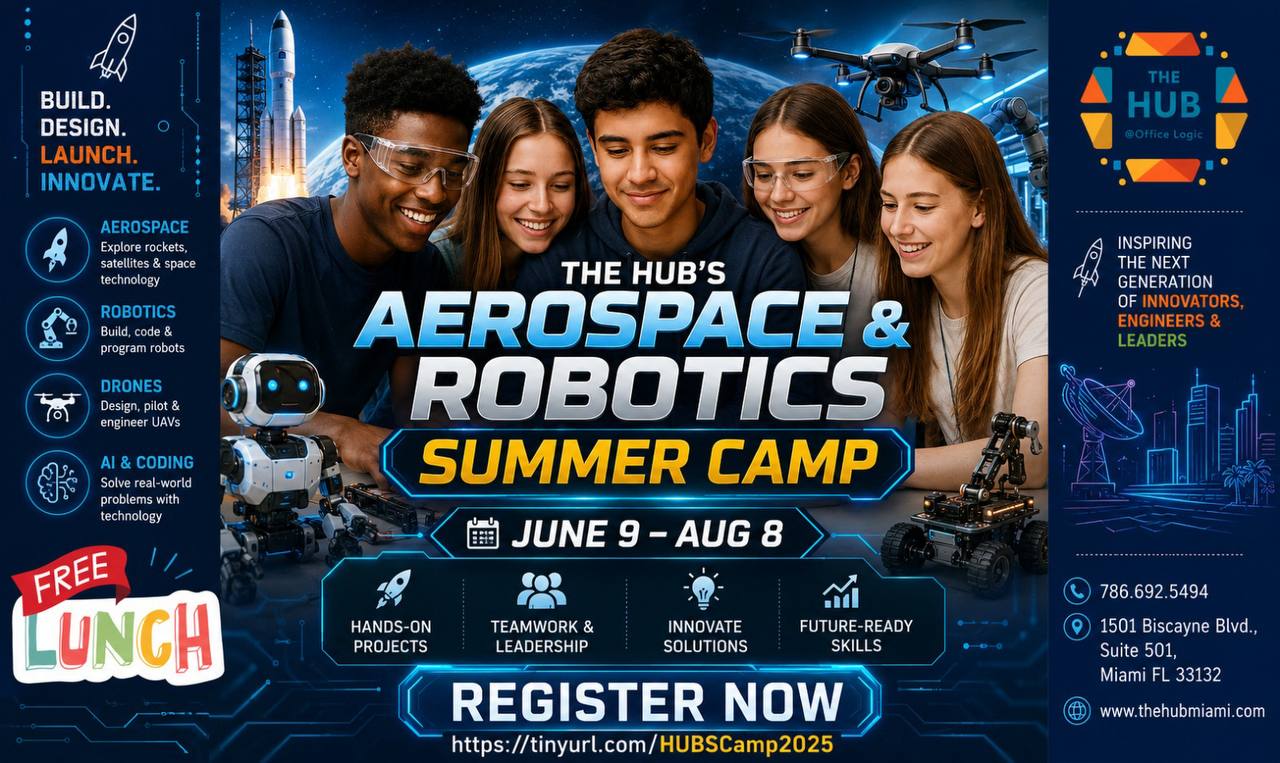
The HUB's 2026 Aerospace & Robotics Summer Camp gives students ages 12–18 hands-on experience with the skills that will actually be in demand — AI, robotics, drone simulation, space technology, and entrepreneurship. Not theory. Not screens. Real projects, real teamwork, real confidence.
No fee. No problem. We will give you a call to see if you’re the right fit.
Fill out the form to reserve a spot →
When asked "How did you hear about us?" — please mention the Supercharged newsletter.
Good morning ☀️, leader of the next generation.
We will talk about agents. AI agents.
They will change the way how we do business, how we interract and even how we do our everyday lives.
Agents will build business.
Agents will organize your day.
Agents will fill up your fridge.
I will let that sit in here for a while, so we can imagine and build the future together one agent at a time...
⚡ WHAT'S AT STAKE TODAY ⚡
- 🤖💡 Amazon hopes to challenge Nvidia more directly by selling its AI chips
- 💼🔍 Source: Elastic agrees to buy CRV-backed DeductiveAI for up to $85M
- 🚀📈 OpenAI is bringing on some big guns in the lead-up to its IPO
- 📱✨ Pixi's new iOS app turns text messages into interactive AR experiences
- 💰🧠 General Intuition in talks to raise $300M at around $2B valuation
- 🌈🤖 'Queer Eye' life coach Karamo Brown launches Kē, a wellness app featuring his AI digital clone
- 📵🐢 The smartphone era created an attention crisis — slow tech is fixing it
- 🎬💸 Snap spins off AI video team into new company, Dotmo, due to costs
- 🔧🌏 The US says ASML's top chip tool may be in China. ASML says it isn't
What’s your #1 financial headache as a business owner?
AWS eyes third-party chip sales to take on Nvidia's AI dominance.
Amazon hopes to challenge Nvidia more directly by selling its AI chips

Amazon Web Services is making moves that could put it on a direct collision course with Nvidia. The cloud giant is exploring the possibility of selling its homegrown AI chip, Trainium, to outside companies for use in their own data centers — a significant shift from its historical approach.
AWS AI chief Peter DeSantis confirmed to Bloomberg that the company is in early talks with potential buyers, though he declined to name specific companies. An AWS spokesperson also acknowledged the shift in direction: "While we've historically declined requests to sell chips directly, Andy noted it's quite possible we'll sell racks of them to third parties in the future."
The idea traces back to Amazon CEO Andy Jassy's annual shareholder letter published in early April. In it, Jassy made a striking claim: if Amazon's chip business operated as a standalone company and sold to both AWS and external customers — as other leading chipmakers do — it would be running at roughly $50 billion in annual revenue. He added that demand for Trainium chips is so strong that selling them directly to third parties seems increasingly likely.
To put that in perspective, $50 billion would make Amazon's chip unit comparable in size to Intel's annual revenue. It wouldn't topple Nvidia — which is currently running at a staggering $326 billion in annual revenue — but it would represent one of the most serious challenges to Nvidia's grip on the AI chip market to date.
So why has AWS waited this long to consider selling its chips externally? The answer comes down to business model. When AWS uses Trainium internally, it benefits from far more than just the chip itself. Every AI workload it processes brings along additional revenue from storage, networking, security, and monitoring services. Selling chips outright to competitors means giving up that broader ecosystem of spending.
There's also the matter of supply. Jassy noted in his shareholder letter that the current generation of Trainium chips sold out almost immediately after becoming available. Even more remarkable, capacity for the next generation — Trainium4, which isn't expected to be available for over a year — has already been reserved. That was before AWS officially added OpenAI to its list of hosted AI models, which will only increase demand further.
Selling chips to outside buyers while existing AWS customers sit on waiting lists would be a difficult position to defend. To make it work, Amazon would need to dramatically scale up production through its manufacturing partners, most notably TSMC. But that's easier said than done. TSMC's production capacity is fiercely competitive, and Nvidia — Amazon's main target — recently surpassed even Apple to become the foundry's largest customer.
The timing of Amazon's ambitions is notable. Nvidia's founder and CEO Jensen Huang recently declared that his company has identified a brand-new $200 billion market opportunity in CPU sales for AI infrastructure — moving squarely into Intel and AMD territory. Meanwhile, Jassy appears equally determined to push into Nvidia's core GPU and AI accelerator business. Both companies are expanding beyond their traditional strongholds, and the lines between cloud providers, chip designers, and semiconductor giants are blurring fast.
For now, Amazon's chip-selling plans remain in early discussions. But the direction is clear: AWS is no longer content to keep its most powerful technology locked inside its own data centers. Whether it can actually execute on that ambition — given supply constraints, manufacturing competition, and the complexity of shifting its business model — remains the real question.
What if your job search ran automatically 24/7?

AIApply is your AI Career Agent working 24/7 to find the best jobs online, tailor every application to your profile, and automatically apply on your behalf so you can spend less time job hunting and more time landing interviews.
Which of these would help your business the most right now?
Elastic acquires AI bug-fixing startup DeductiveAI in an $85M deal
Source: Elastic agrees to buy CRV-backed DeductiveAI for up to $85M

Enterprise software company Elastic is acquiring DeductiveAI, an AI-powered bug detection startup, for up to $85 million. Founded in 2023, Deductive raised a $7.5 million seed round led by CRV, valuing it at $33 million.
The acquisition strengthens Elastic's observability platform by integrating AI that automatically monitors performance and resolves system failures in real time. It also reflects a broader trend of established tech companies acquiring AI-native startups to embed agentic capabilities into their existing products.
Deductive was co-founded by Rakesh Kothari, formerly of ThoughtSpot, and Sameer Agarwal, a founding Databricks engineer.
🎙️ The Supercharged Podcast Is Growing
Real Conversations with the People Building the AI Future

The Supercharged Podcast is quickly becoming a space for real, unfiltered conversations about AI — beyond the hype, tools, and surface-level takes.
Each episode dives deep with founders, operators, and builders who are actively working with AI — or building AI-first companies — to uncover how it’s truly changing the way work gets done.
From strategy and systems to real-world execution, these conversations are practical, honest, and focused on what actually works — not just what sounds good.
⚡ Trends for the Future
OpenAI is bringing on some big guns in the lead-up to its IPO

OpenAI recruits AI legend Noam Shazeer and White House policy veteran Dean Ball.
OpenAI is making bold moves ahead of its anticipated public debut, adding two high-profile names to its roster: Google DeepMind veteran Noam Shazeer and former Trump White House AI policy official Dean Ball.
Shazeer, who is widely regarded as one of the foundational minds behind modern generative AI, announced his departure from Google on Wednesday. He is best known for co-authoring the landmark 2017 paper "Attention Is All You Need," which introduced the Transformer architecture that underpins today's AI systems. Shazeer had been with Google since 2000, with a brief departure to co-found Character AI, the AI role-playing startup. Google rehired him just two years ago in a $2.7 billion deal that also gave the tech giant access to Character AI's technology. His exit is the latest in a wave of high-stakes talent movements between leading AI labs, including Google, OpenAI, Anthropic, and Meta.
On the policy front, Dean Ball announced he will join OpenAI on July 6 to lead a newly formed team called Strategic Futures. The team will report directly to Chief Strategy Officer Jason Kwon and will focus on catastrophic risk, recursive self-improvement, labor market impact, and the relationship between frontier AI labs, governments, and society. Ball previously served in the Trump White House, where he helped publish America's AI Action Plan, before returning to the techno-libertarian think tank the Foundation for American Innovation.
Ball emphasized that the Strategic Futures team will handle both public-facing policy and internal governance, arguing that AI labs will inevitably need to take the lead on governance decisions. "Internal governance will be more central to the future of AI than most people realize," he wrote.
The timing of these hires is notable. As OpenAI strengthens its political and technical standing, rival Anthropic is facing government headwinds — President Trump recently ordered an export control ban on its latest models, forcing the company to pull them entirely. OpenAI's latest recruits signal a clear strategy: lock in insider status while the competition faces increasing regulatory pressure.

⚡ Let’s Make AI Actually Useful:
What Would Move the Needle in *Your* Industry?
AI has potential — but generic advice rarely helps.
What would be genuinely valuable for AI to do in your industry right now?
• Automate a painful workflow?
• Improve decision-making?
• Replace a manual process that wastes time?
• Help your team upskill faster?
Tell us what you’d want AI to handle — or where you feel stuck.
We’re using these insights to curate **industry-specific trainings, live webinars, and practical guidance** you can actually apply.
🌡️ Use the Satisfaction Thermometer to show us how much you enjoyed The Supercharged today ;)

The Supercharged is aiming to be the world's #1 AI business magazine and is on a mission to empower 1,000,000 entrepreneurs worldwide by 2026, guiding them through the transition into the AI-driven creative age. We're dedicated to breaking down complex technologies, sharing actionable insights, and fostering a community that thrives on innovation, to become the ultimate resource for businesses navigating the AI revolution.
The Supercharged is the #1 AI Newsletter for Entrepreneurs, with 25,000 + readers working at the world’s leading startups and enterprises. The Supercharged is free for the readers. Main ads are typically sold out 2 weeks in advance. You can book future ad spots here.
I'm sending this email because you registered for one of our workshops or our affiliates brought you. You can unsubscribe at the bottom of each email at any time.
